I like to use outlines to organize longer papers or presentations. They also can be good task lists. I’ve yet to use one that fits my needs. Dave Winer has written a couple—he’s the RSS developer and developer of the first blogging tool I used back in 2003 called Radio Userland, as well as the early developer of outlining tools. His just don’t fit my workflow. I’ve tried OmniOutliner, but I find it hard to write in and export to either Microsoft Word or my blog.
I wrote a long presentation last week, about 6,000 words, using a new application called Bike. It’s developed by Jesse Grosjean of Hog Bay Software. I’ve also used his text editor, Write Paper, which I like. He has another app called Task Paper which I tried but it didn’t really fit my unique needs.
If you like outlining or are curious about organizing your thoughts, try Bike. It’s good.Oh, it’s a Mac app. It harkens back to a Steve Jobs thought about computers as a bicycle for the mind.
I had an opportunity to speak with Ken Fisher, SVP of Product Management & Solutions Consulting at QAD Redzone, about ways the US can maintain continued manufacturing through the use of technology.
Redzone is a leading workforce collaboration and connectivity solution company acquired by enterprise and MES software company QAD. Fisher told me that MES is primarily a management tool. The Redzone solution focuses on front-line workers, although supervisors and managers also benefit from the collaboration tools.
They use OEE as one measure of effectiveness because it’s an easy way to benchmark, a good way to compare. However, Redzone acknowledges that OEE can also be easily gamed by operators and others, so they apply filters to try to standardize data as much as possible. Evaluating success does not stop with OEE. They also go to the controller to check on P&L numbers such as overtime hours worked.
A plant implementing a new MES may see a productivity improvement by as much as 2%, while a typical Redzone implementation results in about a 29% improvement.
The solution is essentially an app that runs on tablets but is also accessible by smart phone. It’s intuitive to use applying familiar tablet technologies. But the solution is not just an app on an iPad. Redzone’s application also includes coaching on how to best use the tools.
A few features:
Reduces administrative load on operators’ data entry
Gives a voice to the operator using various chat and communication tools
Employee engagement enhanced
Works within a Lean culture
Includes a skills matrix to find the right person to fill a slot in an emergency
Allows personnel to pinpoint and deal with anomalies during the day
These new data from QAD Redzone found that 700 factories raised their overall equipment effectiveness (OEE) by an average of 21 points after just one year of using these types of tools. Additionally, a variety of less-tangible benefits were noted, including enhanced communication and collaboration, greater worker engagement and retention, lower absenteeism, enhanced operational flexibility and agility, and more.
Based on actual anonymized production data directly from the plant and equipment, the productivity benchmark report is the largest and most comprehensive study of plant productivity of its kind. The study includes:
Starting plant performance (OEE) benchmarks by industry
Resulting OEE uplift and productivity improvement
How results vary by continuous improvement (CI) maturity
How results vary by starting point
Estimated annual savings by plant size
Based on on-site assessments, our Engagement Study explores how 50 plants authentically transformed their levels of frontline engagement by tapping into the laws of human nature.
These plants increased productivity and reduced staff turnover by focusing on these five areas of engagement:
Press releases and extensive news coverage provoked some thinking about the Metaverse and its assorted technologies—Augmented Reality (AR), Virtual Reality (VR), eXtended Reality (XR), and Mixed Reality (MR). It’s enough to distort in one’s mind just what is reality. Some psychologists and philosophers think there is no reality outside of what’s in your head. At this rate, they may be right. I even devoted a podcast to thoughts about this.
Mostly I’ve been exploring AR usually in the form of glasses that project the digital over the physical or VR usually in the form of an eye covering totally immersing you in the digital world. I’ve controlled machines while wearing glasses such as Microsoft’s HoloLens and seen training demos in VR. But VR can be on a flat panel, too. My wife the other day was holding her iPhone up and pointing at the walls of her “reading room.” She was visualizing a piece of furniture.
But I am here today to talk about constraints and overcoming them.
Dijam Panigrahi, COO and co-founder of GridRaster, talked with me the other day.
We started with constraints. Even AR requires a lot of compute power. And memory. And networking/communication bandwidth. Not to mention an electric power source. It’s hard to fit all that into an acceptable form factor. Rumors were that Apple was about to release its long awaited AR and VR products. The rumors pointed to the need for the wearer to have a battery pack clipped on their belt with a cable to the device. (For those who don’t wear pants with belts, well, I have no idea what you would have had to do.)
Panigrahi told me they started from a different point. They saw the power of the cloud plus the power of new communications networks such as 5G. Add to this advances in 3D CAD. Why, they asked, should designers try to put everything into the wearable device. Why not host the data in the cloud and use advanced networking to communicate with the device.
GridRaster does not design and sell end user devices. It works with any device and cloud service. It has what they call a unified and shared software infrastructure that enables enterprise customers to run AR, VR, XR, and MR applications.
Here are some underlying ideas and technologies:
Ultra-low latency high fidelity remote rendering using distributed GPUs for graphics heavy computing for high-fidelity rendering without time-consuming polygon reduction, and wirelessly streaming the solution to headsets, mobile phones, and tablets.
Millimeter precision 3D AI based spatial mapping achieving accurate 3D spatial mapping with high fidelity 3D scene reconstruction, scene segmentation, and 3D object recognition using 3D computer vision and deep learning-based AI running on discrete GPUs on the server.
Auto scaling and deployment using DevSecOps applying gaming tools and concepts in a cloud native environment that allows for agile, secure, and rapid development, deployment, and operations on the cloud/on-premises. GridRaster uses Kubernetes for deployment and scaling. It follows a CI/CD pipeline for deployment of its services into the cluster following the best practices and CNCF graduated projects. This enables loosely coupled systems that are resilient, manageable, and observable, and future proof.
Easy API-based integration open architecture approach enables a frictionless onboarding and seamless integration with existing content formats and provides future proof cross-platform support. This also allows the platform to integrate with other systems to share data and allow for interoperability.
And some use cases:
DESIGN & ENGINEERING
Enables Real-time Collaboration for Rapid Prototyping
Enables quick iteration on the ideas and concepts
Clearer communication among team members
Quick decisions.
Precise overlays of virtual models on real-world on any commercially available mobile devices, HMDs, smartglasses and PCs in real-time.
REMOTE MAINTENANCE, REPAIR AND TRAINING
Enables photo-realistic visualization and remote collaboration.
Create a virtual environment close to real world settings, along with photo-realistic product visualization and real-time collaboration, so that the most effective environment can be created for remote maintenance, repair and training.
Combines the best of the gaming and traditional simulations to provide a massive multi-user and multi-platform ultra-realistic large world simulations in AR,VR and MR.
Provides a cloud-based agile and secure deployment and operation that distributes complex computations across compute server nodes and handles scaling in real time using Kubernetes.
Futurist, X-Prize guy, longevity researcher Peter Diamandis appears in my email inbox regularly. This email about emails caught my attention. I receive about a hundred a day. Many are from PR professionals seeking attention for their client.
Evidently they all went to the same school and bought the same template. The subject line seldom tempts me. The opening paragraph attempts to set a context with a trend or recent news item. Then there are a couple of filler paragraphs containing generic marketing words. If I have stuck with it this long, by the fourth paragraph or so, they discuss a little of the product or solution with an invitation for me to publish a guest article (which I don’t do) or an interview that, if I’m lucky, contains five possible topics.
I know several things from this.
They have no personal relationship with me
They have not looked at my blog
They do not know what I write about
They do not know if I’ve covered the topic previously
They cannot come to the point
Therefore, I offer this summary of Diamandis’s post on emails. Visit his site for deeper analysis.
Keep it under five lines
Make the subject line unique, meaningful, and searchable
Use easy-to-read formatting
Put your specific action request in the first line
Make the ask really simple—make it hard to say “no”
If something is really urgent, don’t email—call or send a text
Engineers solve problems. Isn’t that what engineering school is all about in the end? Some classes push knowledge. Most of the classes are about solving problems. Most of those involve math.
In this week’s (January 11, 2023) Akimbo podcast entitled More or Less, Seth Godin discusses the paradox of more or less. If we search more on Ecosia, we cause more trees to be planted that will offset the carbon dioxide we pump into the air when we drive to work. As engineers working in manufacturing and production, we are encouraged to help produce more. But also with less waste. We know that some waste, say methane leaks around the facility, also contribute to climate change.
As Seth “rants” on the subject, his logic points toward “better.” Maybe in my life I don’t need more of something or to make do with less of something else. Maybe I need to pursue better. And better is not always more expensive. I like a good wine. Sometimes I’ve had some excellent wines that were very expensive. We like a wine imported from Spain that I buy on sale from my local beverage store for $9.00. It is great with our dinner or for sipping.
Let us consider that concept of better.
Are we solving the better class of problems? Or, maybe just more of the easier problems that might gain us a little recognition? Or, fewer problems because we are “quiet quitting”?
I suggest that we work on the big problems. The problems that matter. The better problems.
And if you are not listening to Seth Godin each week, you are missing stimulation for your brain.
How to organize my time and improve productivity comprised a false trail to success for me since the time I was introduced to the topic and presented my very own set of DayTimers. I’ve gone the Getting Things Done with David Allen. This blog reflected some of my thinking for a period of time several years ago.
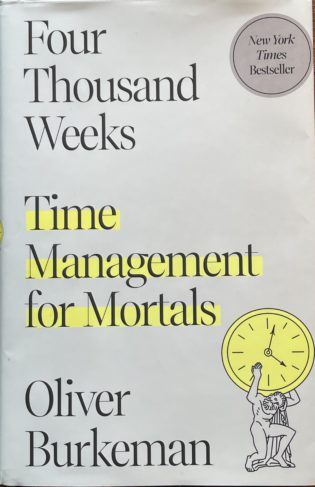
Some of what I learned I’ve used. Much has been discarded. But all was a learning experience. Recently I ran across Four Thousand Weeks: Time Management for Mortals by Oliver Burkeman and subsequently subscribed to his newsletter, The Imperfectionist. A recent issue passed along this thought:
The Zen teacher Kosho Uchiyama once wrote: “Life completely unhindered by anything manifests as pure activity.” Orient yourself to the world in this way, and the question is no longer “How can I get myself to do things?”, with its implicit and unwelcome answer: “By putting in more effort, you lazy jerk!” Instead, the question is something a bit more like “What’s seeking to be done through me, right now?” And then, whatever the response, all you really have to do is to allow it to happen.
Have you experienced bosses who prized activity over results? I have. Drove me crazy.
Break up your day. Figure out the best times for different tasks. Find a way to devote about three hours to that “what is seeking to be done through me” task. Break. Block off a shorter period of time for discrete tasks—email, meetings, calls. Another shorter period for “urgent” to-dos.
My Yoga training has conditioned me to “go with the flow.” Find that thing seeking to be done through me and go with the flow. Accomplish meaningful work.