
by Gary Mintchell | Feb 3, 2015 | Automation, Data Management, News, Operations Management, Technology
 Here is a product release in the area of critical asset management. Prediction data is becoming more prevalent and critical in high performing production plants.
Emerson Process Management has expanded the protection of critical assets to include basic prediction capabilities with only minimal time and wiring investments. These basic prediction capabilities for the CSI 6500 protection system are available in the recently released version 5.61 of AMS Suite: Machinery Health Manager.
Using an Ethernet connection from the CSI 6500, users receive periodic parameter trends and spectrum/waveform data delivered on specific intervals. This data is particularly useful for determining the health of sleeve bearings on turbo machinery. This automated process for acquiring prediction data eliminates the need to connect to buffered outputs on the protection system and reduces the risk of inadvertently causing a machine trip.
In addition, waveform data from the CSI 6500 is now incorporated onto the circular polar plots available in AMS Machinery Manager v5.61, facilitating diagnosis of developing valve faults in reciprocating compressors.
“Expanding the capabilities in our technology is just one way Emerson offers additional value to our users,” said Nathan Pettus, vice president of Emerson’s Reliability Solutions business. “Emerson is committed to developing customer solutions that capture more of the right data, and delivering it in a way that allows users to make real-time, quality decisions on how to operate their assets.”
Emerson’s AMS Machinery Manager integrates data from route-based, online, and wireless vibration solutions as well as third-party oil and infrared analysis data to provide a complete picture of machinery health.

by Gary Mintchell | Dec 22, 2014 | Automation, News, Organizations, Process Control
Here we are at the end of 2014 and we see continuing evidence of the business trend in the industrial process control industry—consolidation.
Emerson announced Dec. 22 that it has acquired Stirling, Scotland-based Cascade Technologies Ltd., a leading manufacturer of gas analyzers and monitoring systems using Quantum Cascade Laser (QCL) technology. This innovative technology measures multiple gases simultaneously, helping companies improve industrial emissions monitoring, production efficiencies and environmental compliance.
Emerson is expanding its analytical measurement capabilities by adding this innovative laser technology to its Rosemount Analytical gas analysis portfolio. QCL technology provides a step change in gas analyzer performance through its increased sensitivity, speed of response, and fingerprinting capability. These technology advancements in the gas analysis market space provide a powerful solution for customers in various industries such as petrochemical, food and beverage, marine, automotive and pharmaceutical. Terms of the acquisition were not disclosed.
“The acquisition of Cascade Technologies is an exciting step as we further strengthen our gas analysis portfolio,” said Tom Moser, group vice president of Emerson Process Management’s measurement and analytical businesses. “Our customers depend upon Emerson to solve their toughest analytical measurement problems. We are now better positioned to serve that need.”
Dr. Iain Howieson, chief executive officer of Cascade Technologies Ltd., added, “Joining a global leader like Emerson represents an incredible opportunity for business growth. Emerson’s global presence and market leadership will have an immediate impact on the adoption of cutting edge QCL gas analyzers and monitoring systems.”
by Gary Mintchell | Dec 19, 2014 | Automation, Networking, Operations Management, Technology, Wireless
 Wireless sensor network pioneer, Emerson Process Management, also recognizes the need for customers to manage the growing proliferation of wireless networks within a facility.
It has introduced the Smart Wireless Navigator, a new software platform that enables users with large wireless deployments to maximize the power of their wireless networks. The Navigator brings together Smart Wireless tools for planning, managing, and maintaining networks. Valuable wireless network and device diagnostics and data are organized in an intuitive interface, along with the wireless tools, to streamline the Smart Wireless experience.
“Wireless technology is as scalable as it is powerful,” commented Bob Karschnia, vice president of wireless at Emerson. “As users’ facilities grow, they are expanding to installations of multiple wireless networks managed by different groups.”
The Smart Wireless Navigator helps users effortlessly manage their expanding wireless infrastructure and get the most value from their networks. A single software platform design makes it easier for users with large deployments of wireless to manage their networks across functional groups, delivering actionable information to the people who need it.
“To maximize value, facilities also needed a central platform to plan and deploy new networks and to organize the influx of new data and diagnostics,” wireless continued Karschnia. “In answer, we developed a single window interface that brings together several Smart Wireless tools on a specially designed appliance to maximize visibility, efficiency and value.”
An intuitive design organizes large amounts of wireless diagnostic information and data, and existing infrastructure is illustrated and easily understood.
“The Smart Wireless Navigator is a comprehensive tool that helps users realize the value of wireless across the range of reliability, safety, environmental accountability and process performance,” summarized Karschnia, “it delivers value throughout the cycle of engineering, installation, operation and maintenance.”
by Gary Mintchell | Nov 12, 2014 | News, Operations Management, Software

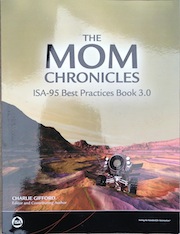
MOM Chronicles: ISA95 Best Practices
The International Society of Automation (ISA) Publications Department has awarded Charlie Gifford the Thomas G. Fisher Award of Excellence for a Standards-Based Reference Publication. The book, which Gifford assembled and edited, is “The MOM Chronicles: ISA-95 Best Practices Book 3.0”.
I have the book and highly recommend it to all who are trying to understand and implement the ideas and models of ISA95—the international standard for the integration of enterprise and control systems. Charlie is an internationally respected practitioner and teacher on manufacturing operations management (MOM).
Charlie offers this comment on the honor, “I sincerely thank ISA for this prominent award named for a distinguished man, Tom Fisher. As Primary Contributing Author and Chief Editor, I accept this award for all 50 contributing expert authors and reviewers of the ISA-95 Manufacturing Operations Management (MOM) Best Practices Working Group. This is the 2nd time the working group’s work products have been recognized for this award. In 2011, ‘When World Collide in Manufacturing Operations, Book 2.0’ was also selected. ISA continues to support the group’s work products of 23 applied technology white papers and 3 books. These documents enable manufacturing systems professionals worldwide to become a primary reference resource over the last 10 years.”
Here is a glimpse into MOM Chronicles:
- Chapter 1: Applying Global MOM Systems in a Manufacturing 2.0 Approach
- Chapter 2: The Role of Semantic Models in Smarter Industrial Operations
- Chapter 3: Applying Manufacturing Operations Models in a Discrete Hybrid Manufacturing Environment
- Chapter 4: Defining an Operations Systems Architecture
- Chapter 5: A Workflow-driven Approach to MOM
- Chapter 6: Scheduling Integration Using an ISA-95 Application in a Steel Plant
- Chapter 7: Intelligent Integration Interface: I3, A Real-world Application of ISA-95
Here’s a glimpse into When Worlds:
- Chapter 1: SOA for Manufacturing Overview
- Chapter 2: Data Architecture for MOM: The Manufacturing Master Data Approach
- Chapter 3: Building a Manufacturing Transformation Strategy with ISA-95 Methods
- Chapter 4: Work Process Management for Adaptive Manufacturing
- Chapter 5: B2MML, Integration Patterns, and Data Mapping
- Chapter 6: Integration of Manufacturing Intelligence with MOM
- Chapter 7: Lifecycle of Service Creation using the ISA-95 MOM
Charlie Gifford, PMP, is General Manager & Senior Advanced Manufacturing Consultant at Intelligent Manufacturing Institute, 21st Century Manufacturing Solutions LLC.
by Gary Mintchell | Oct 8, 2014 | Automation, News, Operations Management, Process Control, Safety
 The major press conference at this week’s Emerson Exchange focused on reliability. As a process control company, Emerson has historically focused on the “O” side of Operations & Maintenance.
But Steve Sonnenberg, president of Emerson Process Management, launched the discussion with the statement, “Reliability as a business strategy – a board-level activity. C-suite executives are seeing the need to better manage physical assets for improved profitability. With the right strategy, the typical $1 billion plant can save $12 million or more annually in maintenance costs.”
Jim Nyquist, group vice president PlantWeb Solutions, expressed the three factors of reliability as safety, availability, and profitability. Expressed as a formula, Nyquist explained “shareholder value = reducing safety incidents, improving availability, reducing maintenance costs.”
“Safety is job one,” Nyquist continued. “10% of time in transient conditions yield 50% of safety incidents. Marsh reports piping failures, startpup and shut down events continue to be significant causes of incidents.” As for availability, as much as 5% of production capacity is lost each year as a result of unplanned shutdown and as much as 43% of unplanned downtime is caused by equipment failure. A 1% gain in availability is worth $8.4 million of additional margin in a typical refinery.
Data leads to information which leads to knowledge and then finally action. For Emerson it begins with pervasive sensing and then asset management and control systems. The next step is to build reliability expertise. The company has been building services business, but it has also recently acquired Management Resources Group (MRG). Not only does this investment boost Emerson’s pervasive sensing solution, it also adds a number of experienced consultants. These consultants will help the company reach the next level of the progression–the “prescription” or the tools that allow customers to take prescription into action.
“If a company is not a top-quartile performer, it is losing millions in revenue and spending millions of dollars on unnecessary maintenance costs,” said Robert DiStefano, MRG’s founder and former CEO. “Every dollar not spent on maintenance goes directly to the bottom line. Our approach helps companies dramatically reduce downtime and enhance safety and compliance, increasing the stature and reputation of a company and ultimately providing better value for shareholders.”
Representative from three customer companies presented cases where monitoring and analysis drove improved business metrics. The companies were Corbion, PolyOne, and Lucite.
This new direction of Emerson’s is going to help manufacturers and producers complete the loop of design to operate to maintain. Plant, division and top managers will be provided a holistic view of operations and will therefore be poised to continually improve efficiency, asset utilization and profitability.