
by Gary Mintchell | Jul 28, 2017 | Automation, Technology, Workforce
The future of work—humans and machines working together in a truly collaborative fashion. A “partnership” said Dell Technologies.
My blogs on the future have not necessarily brought in tons of new page views (but this blog compares pretty well with industry trade publications), but they have drawn the attention of PR agency account managers looking for a way to prove their worth. Sometimes one of the inquiries strikes gold, as they say.
Yesterday James Lawton, Chief Product and Marketing Officer, Rethink Robotics, gave me 30 minutes of his time to talk about a vision of the future for humans and robotics. Rethink Robotics was founded by Rodney Brooks, an MIT professor and co-founder of iRobot (Roomba). I have written about the company several times including here, here, and here. You may remember Sawyer and Baxter, its two robots.

Baxter the Robot
We began talking a little about why robotics conversations got stale for several years. “Perhaps people had written robots off because of the way they were used” he told me. Those were mainly pick-and-place and welding. “If we can break the traditional barriers with automation technologies, then we can begin to see many new applications.”
Rethink Robotics has bee focusing on a handful of form factors—safe by design.
I asked about one of the hot topics among traditional robotic suppliers—collaboration. “Collaboration has been internalized it as ‘run without a cage’ instead of ‘people and robots working closely together’. We need to break that mental model. Some writers are worried about robots replacing people, but it’s about machines making people ‘super people.’ Both physical and cognitive assist to humans,” Lawton mentioned.
Lawton offered this challenge to the industry, “Make it so that ‘robot’ isn’t a custom construction project, but make more like hiring a temp worker. To do this, we need a common language interface, something like Amazon Echo, ‘Alexa do this.’ We have linguistics to overcome to accomplish this. We say pick up box and have an idea of box; a robot needs to be taught about what box means in all of the word’s many varieties.”
What about the near future? “In 5-10 years we’ll see these technologies begin to build out. We’ll also start to see more robotic technology in homes,” he predicted.
As far as collaborating, Peter Senge wrote in his book 5th Discipline that it is hard for humans to learn from patterns when they are separated by time and space. Lawton explained, “Computers, on the other hand, can do that. I can’t pull in all the data and derive insights. Say I’m applying torque to a part I’m assembling. But a computer can archive all the past data and then compare that with customer feedback on the assembly. With robot assist on the production process, it can reconfigure its own work on the fly and we can assemble the part in a way that better satisfies the customer.”
“This change in how we interact with machines will change how we live and how we work, as well as how we create value.”
by Gary Mintchell | Jun 13, 2017 | Asset Performance Management, Automation, Operations Management
This is “TechED” week for Rockwell Automation with “Shelby” the chat bot collaboration tool featured prominently at the opening keynote presentations–a software startup within the organization.
TeamONE was one of two new products featured this week. The other an appliance to help manage an EtherNet/IP network.
More than 2,000 people gathered in Orlando for the 20th edition of this distributor and customer learning event. Most of the sessions were deep dives into product and technology. I’ve sat in a few sessions, and they reminded me of how much I miss the deep dives into how to use products and technology instead of the usual marketing overviews that I receive.
The goals seem to be offering new workforce additions tools that they’ll be familiar with, enabling quicker setup and troubleshooting, and supporting teams.
One other maintenance-oriented product I’ll touch on is a support service for predictive maintenance.
The new products are FactoryTalk Analytics for Devices appliance and a FactoryTalk TeamONE Standard Edition app. These off-the-shelf offerings require minimal configuration and can help solve common maintenance problems faster, which keeps unplanned downtime at a minimum. The appliance and app quickly help improve reaction time for maintenance teams and assist decision makers with health and diagnostics analytics for industrial devices and systems.
“These offerings were built with ease-of-use as a primary goal,” said Michael Pantaleano, global business manager, Rockwell Automation. “We’ve worked closely with our customers on these solutions, proving that an instantly available app and a scalable analytical appliance that work out-of-the-box can deliver immediate value. At Rockwell Automation, we are committed to building tools that are approachable for our customers’ current teams. These two new offerings help maintenance teams easily discover the health of their devices and better collaborate in context with insightful information.”
These offerings are some of the first subscription offerings from Rockwell Automation. To further streamline the adoption process, a new e-commerce portal is used to manage the new offerings. All subscriptions and management can take place within a single, self-service portal.

FactoryTalk TeamONE App
Focused on reducing mean time to repair, Rockwell Automation is releasing a new edition, dubbed the Standard Edition, of the FactoryTalk TeamONE app. The new edition adds an alarm module, enabling teams to collaborate with live alarm details. This gives users the ability to easily view all active alarms. They can also view, share and post new details, delivering better team collaboration by adding context with alarm information. Alarms requiring immediate action can be shared with specific team members or posted to the entire team for group management and resolution.
As a smart node, the FactoryTalk TeamONE app requires no server, device to cloud gateways, or IT setup for manufacturers to realize value, which expands as they go through their digital transformation. The app is currently available on the Apple App Store and Google Play store, and a new user account takes just minutes to set up.
The new Standard Edition is a paid yearly subscription and expands the features available in the free edition of the app. Released in 2016, the FactoryTalk TeamONE Free Edition app provides near-instantaneous incident and device data to plant-floor maintenance teams that include engineering, trades and IT workers. The free edition removes the barriers for industrial teams to collaborate and quickly solve issues with contextualized plant-floor data like trends and device status. Modules in this free edition include Incident, Device Status, Teamboard, Knowledgebase, Pinboard, Chat and Trend modules. Within the FactoryTalk TeamONE app, customers can even have a mix of free and subscription users on their teams.

FactoryTalk Analytics for Devices Appliance
FactoryTalk Analytics for Devices is a hardened appliance that helps avoid costly downtime and improve productivity by proactively identifying device health. With just a connection to power and a local control system network, the appliance begins providing analytics within minutes.
After the connections are made, the application detects automation devices on the network without disrupting performance. Plant-floor teams then gain access to specific calls-to-action, instant device displays and an advanced machine-learning-based chat bot, which are all available from within the appliance. The appliance learns what is important to users by continuously analyzing the devices on the network and delivering recommendations to help maintenance and engineering teams prevent unplanned downtime and repair systems more quickly.
“Our customers are trying to figure out how to take their first steps toward analytics and the industrial Internet of Things,” said Pantaleano. “This appliance is an excellent start to their journey, with tangible results that can help our customers within minutes.”
The FactoryTalk Analytics for Devices appliance can detect and perform a basic analysis on any EtherNet/IP device. The appliance also has detailed analytics for over 2,000 Allen-Bradley devices. The first year’s subscription is included for each appliance. Subsequent subscriptions are encouraged for customers to progressively receive updated analytics, features and device support, including third-party devices.
Predictive Maintenance
I attended a session on predictive maintenance. The topic was a support service from Rockwell Automation–some of which is ready to go now and some still under development. It combines software tools and human experts.
Research has revealed that about 74% of total downtime is figuring out what the problem is and developing a workflow to fix it. The goal of this service by Rockwell Automation is to shorten this time through application of predictive analytics combined with expert analysis.
They have set up a system to collect device data into a Microsoft Azure cloud–aka FactoryTalk Cloud–where analytics apps reside and then port the information into the services organization.
The team has been developing a series of software agents to look at a variety of situations from pattern recognition to anomaly detection to machine learning to help customers get their predictive program up and running “in weeks, not years.”
by Gary Mintchell | Apr 27, 2017 | Internet of Things, Operations Management
If enthusiasm means anything there will shortly be what could be described as an Internet of Things operating system. I reported Monday about a press release I received from the Linux Foundation about a “unification platform for interoperability of protocols for the Internet of Things.” As you may have guessed, I was less than impressed with the press release. This is the EdgeX Foundry.
So, I devoted an hour to Jason Shepherd, the Dell EMC director who is the driver putting this all together in Hannover on Wednesday. He brought me to an architecture diagram. I wish they had sent that with the release.
Internet of Things Loosely Coupled
By way of preface for the geeks in the readership, I refer you to a book, Loosely Coupled, by Doug Kaye. This architecture is an example of what Kaye thought was the future of IT and computing—namely loosely coupled applications.

The architecture is a loosely coupled system of data inputs in a variety of protocols, almost an endless variety, if you will, and a loosely coupled system of applications (gray) brought together by a set of services (purple)—which are open source.
In other words, EdgeX describes the Internet of Things ecosystem bringing in data sources from a variety of protocols, storing the data, performing analytics, and serving out for visualization and action. This action is performed within a gateway device, let’s say for argument’s sake, a Dell Gateway product.
And as a side note, it is capable of also doing control. Now don’t get all excited about that, yet, but you and I both know engineers who like to try out new things that may give them some sort of advantage.
Let’s Contextualize
To place this in a context, this is close to what Siemens is doing with Mindsphere. Siemens is trying to be open. This project is also open source, taking it one step further. Except that there is no company of Siemens’ stature on board, yet.
I interviewed a company called Exosite at Hannover, which is the technology behind the Parker Voice of the Machine (to be described later). This company is trying to do a similar thing, but all within its system. That is its competitive edge—debases and analytics.
Similarly, SAP brings data from lots of sources into its cloud where it can perform all the work with its system.
Then there is Cisco. It controls all the data flow on most networks. Tapping into that data source, it also is building a proprietary system that can do much of this.
Rockwell Automation can do some of this, but again, pretty much within its own ecosystem.
Meanwhile, GE Digital has Predix.
All of those have open connectors into their systems, but the systems remain closed within their own walls.
Thinking Radically
Let’s step outside the box for a second and consider what ExxonMobil is trying to do with its attempt to build an open DCS. There are many similarities to what Dell is doing here. I think ExxonMobil would have been further along partnering with Dell rather than Lockheed Martin who is taking it into the big company direction.
Shepherd and team have already amassed 50 companies committed to the effort. He thinks another 25 are close. Consider that, ExxonMobil.
Shepherd also thinks this is finally the ideal opportunity for smaller companies to disrupt the big company hold on the control market.
by Gary Mintchell | Mar 14, 2017 | Data Management, Internet of Things, Operations Management, Software
Connecting your plant devices through the Industrial Internet of Things (IIoT) generates lots of data; but, without powerful analytics and visualization, it’s all meaningless.
Therefore, Plex today announced a new analytics product.
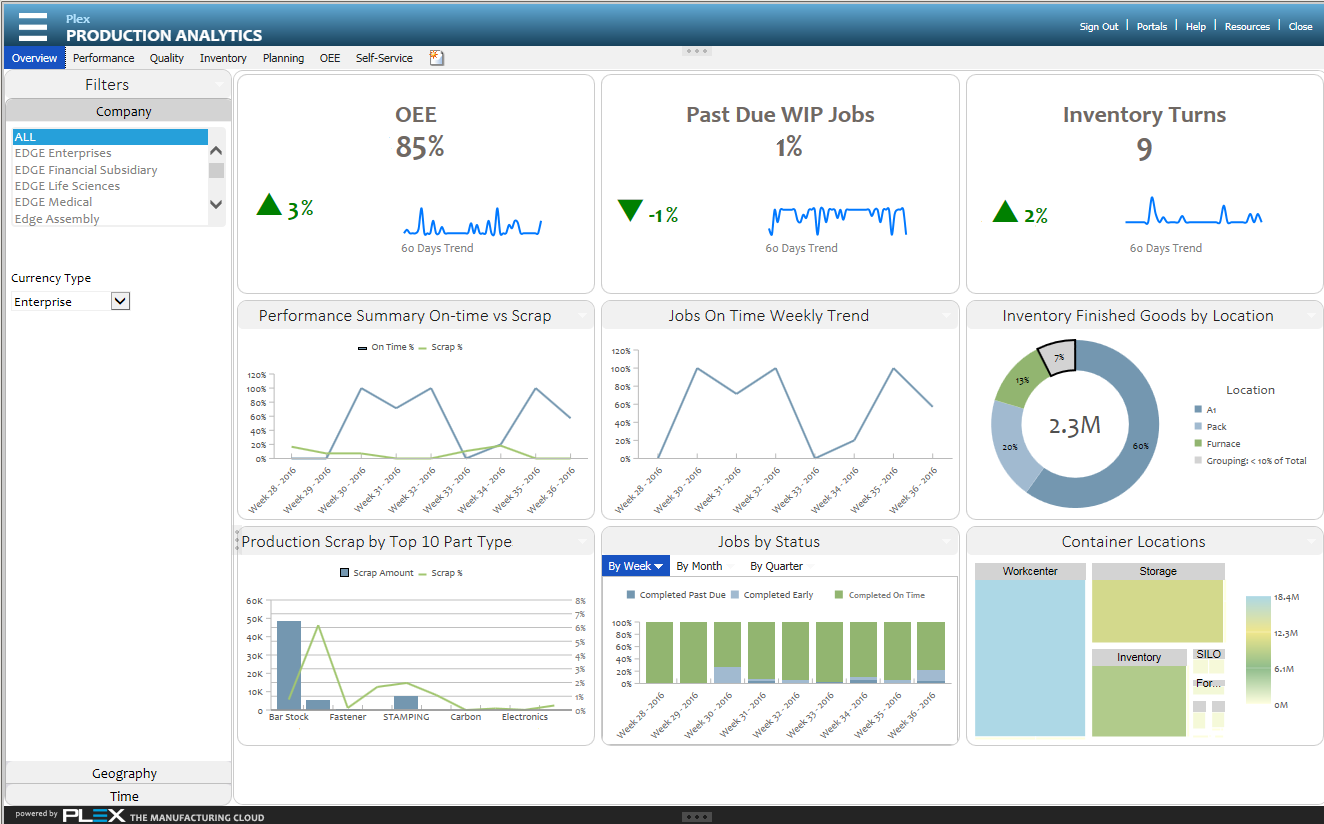
 The IntelliPlex Production Analytic Application, available now, taps IIoT data to provide manufacturing leaders with enterprise-wide insight into the performance of production operations, including processes and equipment on the shop floor.
This application adds to Plex’s IntelliPlex Analytic Application Suite, which includes applications for sales, order management, finance and procurement. This suite, with the addition of production analytics, delivers to manufacturers the industry’s most comprehensive cloud analytics, uniquely providing visibility all the way down to the shop floor.
The Plex Manufacturing Cloud is a comprehensive platform for manufacturing enterprises, connecting suppliers, customers, people, equipment, materials and finances across multiple facilities to form the technology backbone of an organization. Plex uses real-time IIoT connections as a core mechanism for managing manufacturing operations and enterprise resource planning.
That comprehensive view means Plex not only streamlines and automates operations, but also enables unprecedented access to companywide information including IIoT data. The IntelliPlex suite of analytic applications turns that data into configurable, role-based, decision support dashboards – with deep drill-down and drill-across capabilities. Plex first introduced the IntelliPlex Analytic Application Suite in 2016 with turnkey analytics for sales, order management, procurement and finance professionals.
- The IntelliPlex Production Analytic Application provides insight into key performance measures such as overall equipment effectiveness (OEE), scrap rates, first pass yield, inventory turns, on-time jobs and machine availability.
- IntelliPlex is configurable, so users can create custom performance dashboards and combine metrics to form their own analysis based on the wealth of data stored in the Plex Manufacturing Cloud.
- IntelliPlex analytics are also drillable, enabling users to instantly go from top-line performance analysis directly into data and details across plants, time and geographies.
- IntelliPlex applications are easy to activate as part of the Plex Manufacturing Cloud, and can be quickly extended and configured to match an organization’s evolving needs over time.
- The Production Analytic Application is available now.
Plex is planning to deliver additional analytic applications, including supply chain and human capital management. All applications are accessible to customers without the need for a lengthy implementation process.
“At Plex, we know that the best manufacturing organizations are built on the shop floor and that operational excellence is the foundation of product quality, company growth, and profitability,” said Karl Ederle, group vice president of products for Plex. “The IntelliPlex Production Analytic Application is unique because it provides an enterprise-wide view of manufacturing performance, combined with the ability to tap into the IIoT signals from equipment on a specific production line. Plex now offers customers analysis of their organization that truly spans from shop floor equipment to the financial bottom line.”
“This is not an IT tool, it’s an empowerment tool,” said Janice D’Amico, Plex specialist lead, Hatch Stamping. “The IntelliPlex Production Analytic Application has given Hatch access to accurate, near real-time data cross-enterprise that is user-friendly – easy to create, understand and share. We see this application being used at all levels of the organization to make better business decisions. The opportunities are endless.”
“In many manufacturing organizations, there is a communication breakdown between the front office and the shop floor,” said Alexi Antonio, Plex Analytics product lead. “Because the three OEE production metrics—performance, quality, and availability—are not expressed in monetary units, daily efforts to improve processes using OEE alone do not always translate into bottom-line savings. Plex puts OEE and financial metrics into a single dashboard, for the first time giving manufacturing leaders the ability to see and manage complete business performance.”
by Gary Mintchell | Mar 7, 2017 | Automation, Industrial Computers, Software
 One under-the-radar trend in industrial automation and software is the development of a marketplace. Several companies have one type of marketplace or another. I think it’s going to prove to be a powerful concept. Here is a take on it from Advantech.
Advantech, a leader of the global industrial computing market, launches the WISE-PaaS Marketplace, an online software shopping website that features exclusive software services provided by Advantech and its partners. The WISE-PaaS Marketplace provides diverse WISE-PaaS IoT application software, including WebAccess/SCADA, WebAccess/HMI, WebAccess/IVS, WebAccess/IMM, WebAccess/NMS, online IoT cloud services, and IoT security services. The WISE-PaaS Marketplace is a sharing platform to integrate with IoT solutions developed by solution partners to provide the building blocks for customers to upgrade existing business systems to Industrial IoT and Industry 4.0 quickly and easily.
Share Success, Grow Business, and Innovate Services
The Wise-PaaS Marketplace is aimed at diverse solution offerings that provide cloud infrastructure services, security services, integrated WISE-PaaS IoT software services, and domain-focused applications for simple and rapid deployment. The WISE-PaaS Marketplace is a value-sharing platform/ecosystem that enables customers to market unique IoT applications and services, increase business opportunities and growth, and maximize returns under the profit-sharing system.
Ongoing Innovation for Future IoT Trends
Customers can subscribe software services via Wise-PaaS Marketplace with WISE-points included in the WISE-PaaS VIP membership packages to access numerous IoT solutions and create IoT innovations for future IoT trends.