by Gary Mintchell | Mar 28, 2017 | Automation, Education, Leadership, Technology
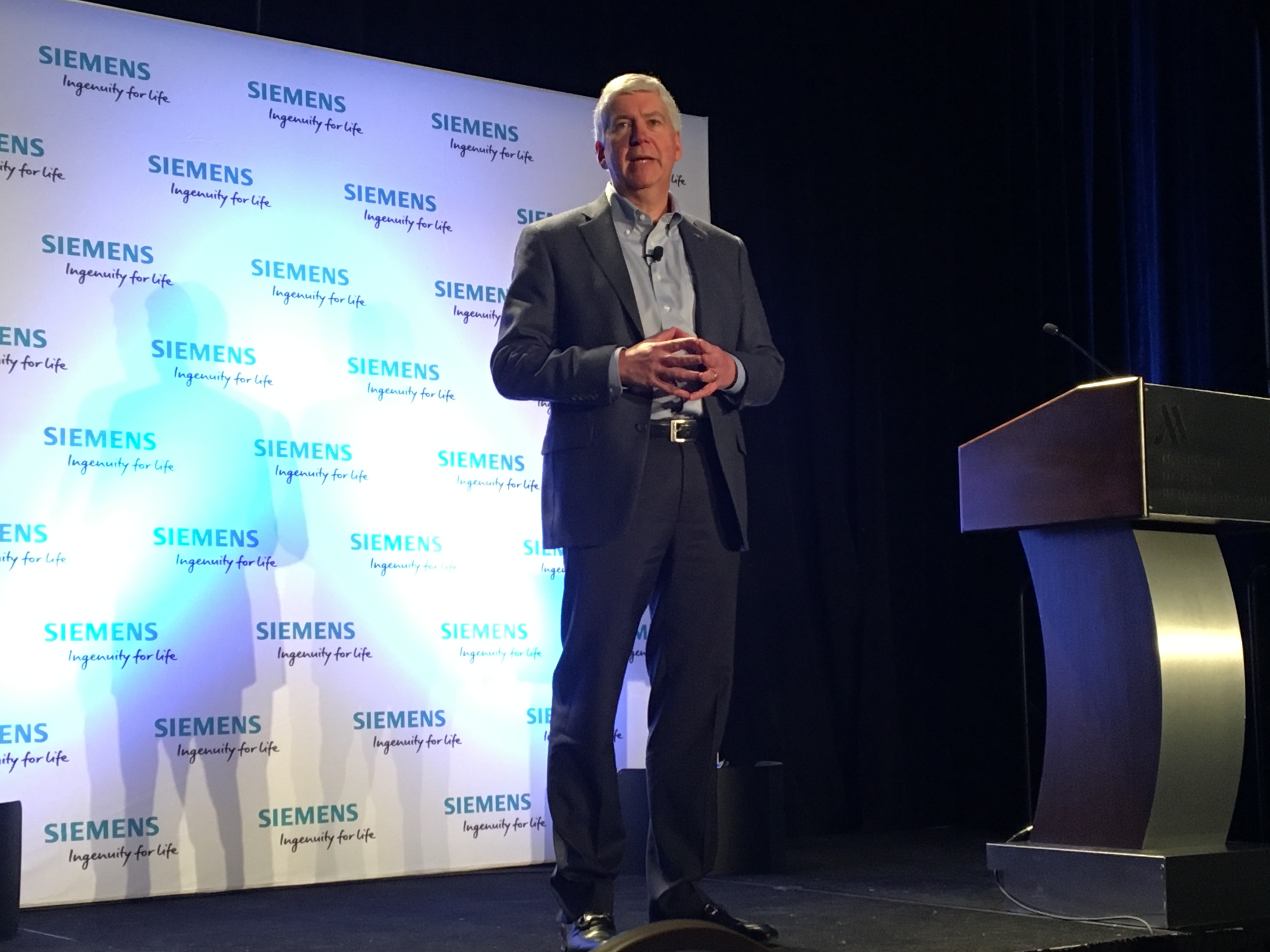
Manufacturing in America—an event bringing together vendors, academia, end users of controls and automation. Siemens Industry, collaborating with its local distributor Electro-Matic, held a trade show/seminar series/thought leadership summit at the Marriott Renaissance Center Detroit March 22-23. The show has a distinct automotive industry feel, as you might expect, even though Detroit, and indeed all of Michigan, is reforming itself along high tech lines with less reliance on traditional automotive.
There was certainly a lot of thought leadership opportunity at the event. There was the Siemens Industry President of Digital Factory. There was the Governor of the State of Michigan.

And then, there was the group of high school students competing in the FIRST Robotics competition known as the ThunderChickens—Engineering A Better Way To Cross The Road. The picture shows a model of their robot. Such passion. Such creativity. The mechanical guy pointed to the control module. “It limits me to 6 motors,” he said. “Last year we only had one, but this year I could have used many more.”
Six motors!! What I’d have given as a kid building stuff to have one! Oh well, they were great.
 Raj Batra, President of Digital Factory for Siemens, said the focus is on digitalization. Digital Twin is a piece of digitalization. This is the digital representation of a physical thing—product, machine, or component. Siemens brought all this together through the 2007 investment in acquiring UGS to form Siemens PLM. “Companies thought it was hype back then, now we know it drives value,” said Batra. “If you are a pure automation company how do you accomplish all this without a design component? You can’t have the digital twin. Meanwhile, a CAE company that doesn’t have automation and control do manufacturing—what do you get?” Batra added challenging the competition.
Batra continued, “We are close to a new era of autonomous manufacturing. And there is the growth of IIoT, we call Mindsphere. This all means manufacturing is no longer a black box to the enterprise. Indeed, it is strategic to the enterprise.”
Paul Maloche, vp sales and marketing Fori Automation, manufacturers of automated guided vehicles, discussed the methods by which collaboration with suppliers (in this case with Siemens) leads to innovation. Fori was diversifying from reliance on building machines for automotive applications, and evaluated the aerospace industry. The Siemens rep came in and said they could help get them into that market. But Fori would have to convert to Siemens control. The Fori team replied, “OK.” This led to development of automated guided vehicle technology and products. The partnership opened doors. Fori won several orders in aerospace market for the new AGVs with Siemens control.
 Alistair Orchard, Siemens PLM, riffing off a space movie, began his talk, “Detroit, we have a problem.” All the old business models of trying to ship jobs overseas has not worked. We need to make stuff to be successful as a society. “So much of what we do has not changed in 50 years in manufacturing,” he noted, “but digitalization can change everything. Additive manufacturing can lead to mass customization due to 3D printing using the digital twin. You can try things out, find problems in design or manufacturing. You can use predictive analytics at design stage. Digital enterprise is about manufacturing close to the customer.”
 Governor Rick Snyder, Michigan, touted his manufacturing background as former operations head at Gateway Computers. “As governor,” he said, “it’s about how you can build an ecosystem and platform for success. Long term, success needs talent. His philosophy contains the idea that we shouldn’t tell students what they should study, but let them know where opportunities are and how to prepare for them. The private sector needs to tell government what they need in the way of talent.”
Michigan has grown more manufacturing jobs than anywhere else in the country. Not only manufacturing, though, Michigan is also a center of industrial design. But the economy not only needs designers and engineers, but also people in skilled trades. “We need to promote that as a profession. We must break the silos that said your opportunities are limited to your initial career choice.”
Michigan has invested a lot in students, especially in FIRST Robotics, where Michigan teams have risen to the top. The state has also started a computer science competition in cyber security.
How are you innovating and making the world better?
 Josh Linkner, CEO Detroit Venture Partners, gave the keynote address on innovation. I’ll leave you with his Five Obsessions of Innovators.
1. Curiosity—ask open ended questions
2. Crave what’s next—future orientation
3. Defy tradition—use Judo flip to turn idea on its head
4. Get scrappy—grit, determination, tenacity
5. Adapt fast
by Gary Mintchell | Feb 23, 2017 | Internet of Things, Manufacturing IT
 The afternoon stream I moderated at the Industry of Things World conference focused on connected vehicles—Construction Equipment, Trucks, Airplanes. I also interviewed a farm equipment manufacturer about some perhaps surprising uses of data-driven decision making in agriculture.
But first, a thought from another keynote address:
From a NASA study—If you want to employ a creative genius, you’ll have 98% success employing a 3-5 year old; if you hire an adult, you probability of success drops to 2%.
Data-Driven Agriculture
I caught up with Alexander Purdy of John Deere between sessions. He’s not an engineer or IT manager like many of the attendees and speakers (he had a later keynote). He on the business end. How can John Deere grab a competitive advantage and serve customers through connected data? After a career as a consultant, he loves actually doing things.
His group deals in guidance systems and digital solutions. Guidance systems essentially link a GPS to large farm equipment. Not only does this ensure the rows of corn are nice and straight, the digital decision making increases coverage and yield.
Deere’s digital solutions include online JDLink, JDonline, and an ops center. A farmer can sit in her office and plot out planting regimes setting up everything before going into the field. There is even a way to collaborate on methods and local information.
Let’s take seeding for example. Sensors connected back to the system can feedback soil conditions. This helps the planter decide for each seed in a cornfield the optimum x, y, and z (yes, they measure depth of planted seed). The idea is to get each plant to grow at about the same rate.
Connected Construction Equipment
Kjell Jespersen, Caterpillar, spoke on huge construction equipment. Customers have been using the large amount of data generated by construction equipment mainly for improving maintenance. However, they crave better productivity data to manage their business. Developing the systems for gathering and analyzing all the data will become crucial as a competitive advantage—or failure to do so could force a company to exit the business.
Connected Trucking
Turning to the long-haul trucking business, companies are turning to truck suppliers such as Volvo and Mack Trucks to provide connected vehicle technology to provide data for improved customer support. According to Evandro Silva, Manager Connected Vehicle Services, Volvo Group Trucks North America, a telematics solution was used to develop a connected service that enables quick diagnosis of issues, proactive scheduling for repairs, and confirmation that needed parts are in stock and ready to install—all while the truck is still on the job.
Airplane Digital Twin
Robert Rencher, Senior Systems Engineer and Associate Technical Fellow, The Boeing Company, took the discussion to a new level—literally. From equipment that stays firmly on the ground, Rencher discussed the role of a “digital twin” throughout the lifecycle of an aircraft. A digital twin is defined within a system representing the characteristics of the object and the virtual environment in which the digital representation of objects and their physical equivalent, vice versa, are represented digitally and co-exist such that the object’s past, current, and future capabilities and can be assessed and evaluated in real-time. As an object progresses through each phase of its lifecycle, various systems interface with the digital twin.
Next Year
Look for information about next year’s conference and all the other conferences. Next year will be about the same time of year in San Diego. Details are still being worked out. Check out twitter conversations at #IoTClan
by Gary Mintchell | Nov 22, 2016 | Automation, Manufacturing IT, Networking, News, Technology
Last week was GE Digital’s Minds + Machines Conference in San Francisco. This Industrial Internet (or Internet of Things to the rest of us) gathering showcases the latest of GE’s digital portfolio–including GE Automation and Control (the successor to GE Intelligent Platforms, successor to GE Fanuc Automation, whew).

Jim Walsh

Rich Carpenter
I tried to arrange my schedule to make it out there, but there had been too many trips in Sept., Oct., and Nov. for my time and expense budget to make it. So, we had a conference call meeting with Jim Walsh, President and CEO of GE Automation & Controls, and Rich Carpenter, Product GM of Control Platforms also at GE Automation & Controls. We talked about the Industrial Internet, digitalization, and new products.
Included in my news below are additional news from the M+M event including acquisition and product news.

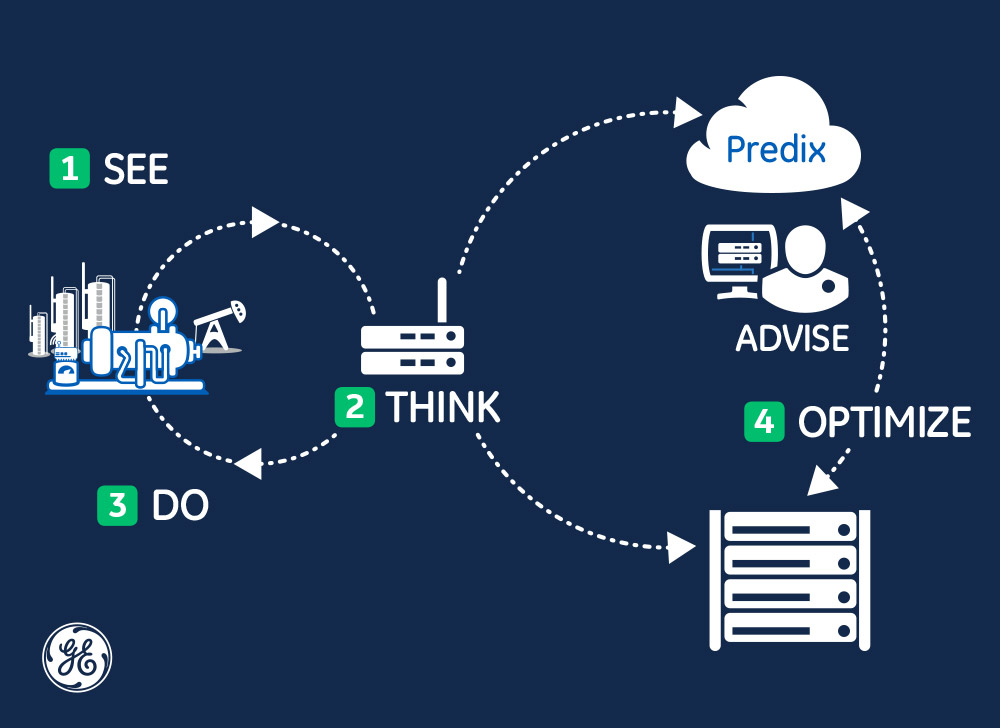
The point most interesting was Walsh and Carpenter discussed the edge device of the network as the controller (PLC). (See the graphic) Almost all of the other companies I talk with are developing an edge device separate from the controller. Carpenter described the closed loop control as “see-think-do”, and then the Industrial Internet plus Predix (GE’s cloud-enabled software product) analytics adds an “optimize” loop to the controller. It can then reflect back on experience and make changes as necessary.

Take for example large pumps in a water/wastewater application. They, of course, are energy consumers. By adding analytics from Predix, the controller could be modified to operate in a more energy efficient manner. One example proved out a $1.5 million per year savings. Another benefit is productivity improvements which Walsh said they had witnessed personally. They referred to the Industrial Internet Control System (IICS), which I will discuss later [Note: much like my Automation Fair update, this one will be long, because there is so much.]
And now, on to the news.
- GE releases new suite of Predix applications and services; introduces the Predix System
- Acquisition of Bit Stew Systems enables efficient data ingestion for industrial applications
- Acquisition of Wise.io strengthens machine learning and data science capabilities for Predix and enables enhanced Digital Twin development
- Meridium acquisition places GE in the lead for Asset Performance Management app development; acquisition of ServiceMax positions GE to lead in service transformation
- Ecosystem expands with independent software vendor program to speed industrial application development; more than 19,000 developers now building on Predix
- Digital orders on track to exceed $7B, a growth of 25%+ in 2016
- Digital thread productivity exceeds $600 million and accelerating into 2017
In 2016, orders from GE’s portfolio of software solutions are on track to climb 25%+ to more than $7 billion. Demonstrating the strength of Predix within GE, digital thread productivity will exceed $600 million, accelerating into 2017.
“The opportunity for industry is now,” said Bill Ruh, Chief Digital Officer of GE and CEO, GE Digital. “The Industrial Internet is profoundly transforming how we operate and our ability to deliver greater productivity for GE and for our customers. Connected machines, coupled with deep machine learning, are more powerful than anything we have seen. These strategic investments in both the Predix platform and our partners continue to attract industrial companies and provide them with tools they need to embark on their own digital industrial transformations.”
EXTENDING PREDIX FROM THE EDGE TO THE CLOUD
GE unveiled a new suite of software and applications.
This release will focus on expanding the platform and scaling development of Digital Twins – virtual representations of physical assets that comprise the world’s industrial infrastructure – through Predix apps and toolkits.
This new set of components can run on a variety of operating systems, devices and form factors – from sensors and controllers to gateways, server appliances and the cloud – making Predix a distributed system for the Industrial Internet and a complete “edge-to-cloud” offering.
GE also launched new Predix-based solutions, designed to help customers harness the power of the Industrial Internet:
Current, designed to analyze and optimize energy use and operational efficiency use across lighting, HVAC and other systems.
Digital Substation, extends maintenance optimization to the electricity grid.
Health Cloud, Cloud-enabled patient outcomes are linking clinical feedback to transformative radiology pathways.
Predictive Corrosion Management, a new Asset Performance Management (APM) solution that provides continuous inspection data and cloud-based analytics of pipe conditions to help operators manage corrosion-related risk.
Digital Power Plant software for gas, steam and nuclear plants, which features new tools to help customers reduce unplanned downtime by up to 5%, reduce false positive alerts by up to 75%, and reduce operations and maintenance costs by up to 25%.
Digital Hydro Plant, a suite of apps combining both software and hardware solutions designed to support Hydro customers globally, helping them get the most out of assets over the lifetime of a plant.
ACQUISITIONS
GE Digital announced it has acquired Bit Stew Systems to bring its data intelligence capabilities to Predix and other industrial solutions. Bit Stew applies its machine learning and artificial intelligence (AI) capabilities to automate the process of data modeling, mapping and ingestion, accelerating time to value for customers, such as BC Hydro, Pacific Gas & Electric and Scottish & Southern Energy. This acquisition will help GE Digital provide a solution to organize large amounts of data through efficient data organization at the edge or at the source of the data – the asset.
GE Digital also acquired Wise.io, a leading machine learning and intelligent systems company. This acquisition will enable GE Digital to further accelerate development of advanced machine learning and data science offerings in the Predix platform. The Wise.io team deepens GE’s machine learning stack and will spearhead innovative solutions in GE’s vertical markets to develop its machine learning offerings.
GE also announced a program dedicated to independent software vendors (ISVs), aimed at spurring development of industrial solutions and extending the reach of the Predix platform. Through these partnerships, GE will share its industry expertise and allow partners to use Predix as the building block for new industrial applications to enhance various components of industrial operations – such as maintenance, content development and asset management.
Inaugural launch partners include: Box, Decisyon App Composer, Entercoms, Ericsson, Mobideo, Nurego, OAG Analytics, Pitney Bowes and Splunk. The addition of ISVs enhances the growing ranks of the GE Digital Alliance Program, which launched in February. The alliance program now boasts more than 270 partners around the world, including major enterprise players such as AT&T, EY, Intel, Microsoft and Tata Consultancy Services (TCS).
GE’s Industrial Internet Control System

GE’s Automation & Controls business introduced GE’s new Industrial Internet Control System (IICS) at its 2016 Connected Controls Symposium at the company’s Global Research Center in Niskayuna, NY. IICS delivers new levels of productivity for industrial assets and processes by integrating controls with Industrial Internet analytics – at scale yet modular and flexible for industrial settings worldwide.
Early IICS adopters report a +7% gain in asset performance and 22% increase in efficiency. By leveraging GE’s deep domain and controller expertise, the IICS solution empowers customers to improve operational efficiency, optimize production and unlock new revenue opportunities.
The system utilizes GE’s Field Agent technology as the gateway between the asset and the Industrial Internet. Field Agent provides a rugged, pre-configured solution for secure data collection and conveyance from the machine to fuel analytics that improve operations.
GE’s Industrial Internet Control System also includes:
- Industrial Cloud Platform – Provides real time process optimization and control; minimalizes disruption to deployed application; Creates new value over time without having to retrofit
- Secure Cloud Connectivity – Predix ready; Provides secure data collection; Enables advanced analytics; Form factors to meet the need
- Outcome Optimizing Controllers – Real-time control; Defense in-depth security; Decreases time to market; Helps reduce unplanned downtime and enhance system performance
- Mix & Match I/O – Remote, real-time diagnostics; Wide range of communication options; Modularity-simple scalability; Drives improved availability and simplified maintenance
- Professional Services – Real Time control; Security at its core; Decreases time to market; Helps reduce unplanned downtime and enhance system performance
- Intelligent Apps – Real Time Control; Security at its core; Decreases time to market; Helps reduce unplanned downtime and enhances system performance
IICS features dual or quad core configuration which provides safe and secure communication with either cloud-based or locally hosted algorithms and applications.
Two structural innovations make the new solution “future proof” for customers, who want hardware assets to be long-lived but remain optimally functioning.
- Industry-first Hypervisor control technology that separates operations from software so that the software can be upgraded without affecting the physical controller, allowing the hardware to stay in place and up to date.
- ComExpress processor technology that allows the processor to be updated as needed, again without replacing the controller. This is critical to support the growing computational power available from the Industrial Internet, including GE’s Digital Twin predictive model for optimizing assets with minimal interruption.
by Gary Mintchell | Jul 18, 2016 | Automation, Operations Management, Software

SafeMove2
[Industrial] “Software’s Where It’s At.” The blog title was intriguing. It was implied that industrial software was increasingly more important than hardware. Then I began to look at my accumulating queue of news. There is a bunch. Here is a sampling. It appears that more innovation time and investment is going into software than hardware. What do you think? Software is now where it’s at?
Cloud and Analytics
GE and Microsoft announced a partnership that will make GE’s Predix platform for the Industrial Internet available on the Microsoft Azure cloud for industrial businesses. The move marks the first step in a broad strategic collaboration between the two companies. This continues a trend I’ve noticed recently of a newly resurgent Microsoft adding clients to Azure cloud.
“Connecting industrial machines to the internet through the cloud is a huge step toward simplifying business processes and reimagining how work gets done,” said Jeff Immelt, CEO of GE. “GE is helping its customers extract value from the vast quantities of data coming out of those machines and is building an ecosystem of industry-leading partners like Microsoft that will allow the Industrial Internet to thrive on a global scale.”
Bringing Predix to Azure, according to GE, means industrial customers will now have access to additional capabilities such as natural language technology, artificial intelligence, advanced data visualization and enterprise application integration.
Microsoft predicts Azure will support the growth of the entire industrial IoT ecosystem by offering Predix customers access to “the largest cloud footprint available today”, along with data sovereignty, hybrid capabilities, and advanced developer and data services. In addition, GE and Microsoft plan to integrate Predix with Azure IoT Suite and Cortana Intelligence Suite along with Microsoft business applications, such as Office 365, Dynamics 365 and Power BI, in order to connect industrial data with business processes and analytics.
“Every industry and every company around the world is being transformed by digital technology,” said Satya Nadella, CEO, Microsoft. “Working with companies like GE, we can reach a new set of customers to help them accelerate their transformation across every line of business — from the factory floor to smart buildings.”
Software’s Where It’s At
This is the blog that brought my thinking to a focus. ARC analyst Mark Sen Gupta wrote about a recent CEO appointment. Honeywell recently announced that Dave Cote is retiring after 14 years at the helm and will be succeeded by Darius Adamczyk.
In the announcement Mr. Cote states, “Scanning & Mobility and Honeywell Process Solutions are software-based businesses with advanced offerings that blend physical and digital capabilities, and they serve as benchmarks for where the rest of Honeywell is heading. Darius’ deep expertise in software will open new growth paths for all of our businesses, which are blending Honeywell’s advanced software programming capabilities with leading-edge physical products and unparalleled domain expertise in a wide variety of industries.” This is a very interesting statement because it recognizes a crucial shift in automation.
Says Sen Gupta, “When we think of automation we normally think of hardware: DCS, PLC, sensors. However, most of the innovation in the industry is happening in software. This aspect of automation innovation has not escaped the attention of ExxonMobil and has led to culmination of it’s open automation initiative. IIoT, cloud, analytics, edge computing have far more to do with what is provided from a software aspect than from a hardware aspect. This is not to say that hardware has no value. In fact if you were to check the balance sheets, you would find that the large automation companies earn more revenue on what we consider hardware, and something has to host the software.”
Digital Twin
Fellow ARC analyst, Dick Slansky recently wrote on how manufacturing and production systems will undergo significant changes. He foresees the eventual realization of the “lights-out” factory with adoption of all the new digital technologies.
“This is a case of leading PLM solutions providers offering advanced analytics solutions applied to the manufacturing processes and to operational optimization. The common objective is to use predictive and prescriptive analytics to improve the overall performance of production operations.”
He continues, “One of the most sought after but elusive goals of product design engineering is to validate that you have achieved all the design criteria in the as-built product. That is, closing the loop between the as-built to the as-designed, and validating that the physical product will meet all design criteria before the product is manufactured. This is where the concept of the digital twin in now being applied to product design criteria, and the goal of ‘closed-loop PLM’.”
“As IIoT, the digital thread and digital twin evolve within the overall ecosystems of product and process, the methodologies, including analytics, for both product development and production processes will converge. The intent and goal of the digital enterprise is to maintain a continuous and real-time digital thread that connects the lifecycle from concept through design, test, and build, to supply chain and products in field.”
ABB Robotics
There has been little radical innovation within industrial robots for some time. Improvements, yes; Innovation, not so much.
But ABB has been working on the software side. It just announced SafeMove2, the latest generation of its safety certified robot monitoring software.
SafeMove2 includes a host of cutting-edge safety functions, including safe speed limits, safe standstill monitoring, safe axis ranges and position and orientation supervision. The new generation functionality encourages the development of innovative robot applications by integrating safety features directly into the robot controller.
“To be efficient, robots must be able to move at speeds suited to the given application. At high speeds this can present a potential hazard for people working in the immediate vicinity. Historically, fences or cages have been used to separate man from machine in an effort to keep them out of harm’s way,” says Dr. Hui Zhang, Head of Product Management, ABB Robotics. “SafeMove2 allows robots and operators to work more closely together by restricting robot motion to precisely what is needed for a specific application.”
SafeMove2 allows for the creation of more efficient and flexible production scenarios, and provides tools that speed the commissioning workflow for faster setup and validation. It also integrates safety fieldbus connectivity into ABB’s IRC5 robot controller family as well as the IRC5 Single, Compact and Paint controllers.
by Gary Mintchell | Mar 2, 2016 | Operations Management, Software
Much time has been invested learning about GE’s new directions, including GE Digital, Digital Twin, Digital Thread, Industrial Software, and Industrial Internet of Things. Then I saw news coming from GE’s annual report–that it has a $5 billion industrial software and analytics company within it that is growing at 20% annually. That is a significant industrial software giant. Letting the GE letter speak for itself:
Digital Industrial
“We are just beginning our transformation as the Digital Industrial Company. The Internet has had a massive impact on consumer productivity and commerce. Its impact on industrial markets is just now being realized. By 2020, 10,000 gas turbines, 68,000 jet engines, more than 100 million lightbulbs and 152 million cars will be connected to the Internet.”
“At GE, we have decided to generate and model this data ourselves—both inside the Company and with our customers. This is what we mean by becoming a Digital Industrial. Our Digital Industrial capabilities will expand our growth rate, improve our margins and bring us closer to our customers.”
As for the Industrial Internet of Things
“There was a time when every sale had a clear endpoint, followed only by routine service and maintenance. Now, sensors on our products send constant streams of data, analyzed and translated into upgrades that drive productivity in industries where even the smallest incremental efficiency can mean very large gains. Capturing it will be a mission in every one of our businesses. Our aspiration is to offer with every GE product a pathway to greater productivity through sensors, software and big-data analytics.”
Benefits
“Our investments are aimed at delivering more productivity for our customers and GE. The performance, so far, of technology companies to generate industrial productivity has been subpar. Industrial productivity, which averaged 4% annually from 1990-2010, is only 1% today. This is because pure connectivity does nothing to create value. Operational productivity requires domain data, physical and digital engineering models, industrial analytics and the ability to modify machines to achieve different outcomes. Ask a hospital CEO how their results have changed once they implemented a new Electronic Medical Record System, and the answer is typically silence. They still lack the data that drives outcomes.”
Industrial Software Killer App
“The ‘killer app’ for the Industrial Internet is GE’s Digital Twin. GE is creating living digital profiles of 500,000+ industrial machines in the field to provide new opportunities for customer growth and productivity. The Digital Twin is a software model of a physical asset or process that will make it possible to manage more precisely than we ever thought possible and deliver better outcomes. The Twin will create new business models and services for GE’s customers and our businesses. On the GE90 engine, we have used Digital Twins to increase fleet availability while saving tens of millions of dollars in unnecessary service overhauls. In rail, we are using Digital Twin models of the Evolution Locomotive to enable our customers to minimize fuel consumption and emissions. The data economy for the industrial world has arrived, and GE is in a unique position to lead it. We enter it bringing decades of deep domain expertise about our industries and volumes of data about our machines and their processes that no one else can match.
Top 10 Software Company
“With this technical leadership, GE can become a top 10 software company by 2020. At the center of this effort is our cloud-based operating system, Predix. Predix offers our customers complete situational awareness to monitor, and continually improve, equipment performance. In practice, it will assure everyone in a given enterprise–whether it’s an airline, a hospital, a railroad, an oilfield, or a wind farm–a real-time stream of relevant information, accessible on mobile assets. Everything we are doing in data and analytics comes together in this operating system.
“We plan to open Predix to our customers and other industrial companies. This gives GE a unique opportunity to create value in the platform ecosystem. We launched Predix in the second half of 2015. By the end of 2016, we expect it to have 200,000 assets under management, 100 GE applications and 20,000 developers creating many more applications.”
Proof of Industrial Internet
“GE applications provide a show site for the Industrial Internet. This year we will generate $500 million of productivity by applying data and analytics inside GE. We will have 75 ‘brilliant factories’ driving yield, cycle and uptime through model-based design. We are using model-based design on our New Product Introductions which allows us to develop and launch new products with reduced cycles, lower cost and higher quality. We can correlate material usage with product performance to change the work scope in a service agreement which drives productivity for GE and the customer.”