
by Gary Mintchell | Jul 13, 2015 | Automation, Networking, News
 Among the earliest conversations I had about using Ethernet in industrial control were with Mark Fondl—then vice president with Modicon, now Schneider Electric. He was a strong advocate long before anyone else (other than Benson Hougland at Opto 22) foreseeing the power of Ethernet as the networking medium of choice.
After the Schneider acquisition of Modicon and the subsequent downgrading of that type of automation within the company, Fondl left, founded Network Vision, and developed a handy little tool for managing industrial Ethernet networks called IntraVUE.
In what I hope a success story for an entrepreneur, Fondl has sold the assets of Network Vision and the IntraVUE tool to networking supplier Panduit. That company has been an integral part, along with Cisco and Rockwell Automation in the Industrial IP Advantage project.
Press Release
Here is the news from the press release. Panduit Corp. announced it has completed the acquisition of IntraVUE by Network Vision Inc. This acquisition increases the Panduit Industrial Automation Infrastructure offering to its customer base with a tool for visualization and diagnostics of Industrial Ethernet control networks.
“The Panduit offering and route to market complements IntraVUE by combining our ability to bridge the physical installation of the infrastructure to the applications supported by the network with the world-class developer and provider of physical infrastructure solutions”
Automation networks are susceptible to interruptions which often result in downtime, and lost production. While conventional tools are frequently unable to detect many types of network interruptions, IntraVUE provides the capability to identify and report information critical to improving uptime of the Industrial Ethernet infrastructure.
According to Matthew O’Sullivan, Panduit EVP of Industrial Automation Infrastructure business, “The proven capabilities of IntraVUE and the expertise of the team will provide our customers with the ability to increase the reliability of their network infrastructure and as a result, improve operational uptime.”
“The Panduit offering and route to market complements IntraVUE by combining our ability to bridge the physical installation of the infrastructure to the applications supported by the network with the world-class developer and provider of physical infrastructure solutions,” said Mark Fondl, founder, Network Vision Inc.
Deployed globally, IntraVUE is a tool trusted by industrial controls professionals to assure network uptime for manufacturing plants that use Ethernet technologies as a part of their controls and automation network. This tool provides network diagnostic capabilities in addition to real-time visualization and monitoring of the Industrial Ethernet network, helping manufacturers proactively improve the uptime of their Industrial Ethernet infrastructure.
by Gary Mintchell | Jun 29, 2015 | Automation, Internet of Things, Networking, News, Operations Management, Technology
 The Internet of Things (IoT) is nothing if not about connectivity. Connecting edge devices to control and information platforms is nothing new to industrial systems, but technology advances attempt to make things easier and faster to deploy.
Cisco’s connectivity products and technologies have long been at the core of enterprise networks. Cisco has also partnered with automation companies such as Rockwell Automation, Emerson Process Management, and Honeywell Process Solutions.
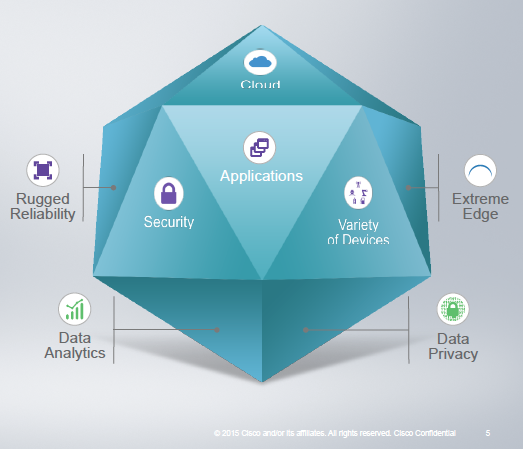
Cisco just announced its latest extensions to the technology. The new Cisco IoT System addresses the complexity of digitization “with an infrastructure that can manage a growing mix of endpoints, platforms and the data deluge.”
Within the new Cisco IoT System framework, Cisco introduced more than 15 new IoT products across six pillars to address the complexities of digitization and help organizations deploy, accelerate and innovate with IoT. Together, the framework supports the infrastructure growth requirements that organizations are facing with IoT by helping raise operational efficiency, create new services, and improve quality and security.
Six‐Pillar Approach for Cisco IoT System
The Cisco IoT System integrates six pillars that must come together for a successful IoT solution and deployment:
- Network Connectivity: Includes purpose-‐built routing, switching, and wireless products available in ruggedized and non‐ruggedized form factors.
- Fog Computing: Extends cloud connectivity closer to the edge to produce immediate insights and efficiently analyze and manage d Cisco predicts that 40% of IoT ‐created data will be processed in the fog by 2018. Over 25 of Cisco’s network products are enabled with Cisco’s fog computing or edge data processing platform, IOx.
- Security: Connects cyber and physical security for visibility into both physical and digital assets, to increase protection and expand operational benefit Cisco’s IP surveillance portfolio and network products with TrustSec security and cloud/cyber security products allow users to monitor, detect and respond to combined IT and Operational Technology (OT) attacks. Organizations in industries such as manufacturing and energy are increasingly working to integrate proprietary process control systems with the IP network infrastructure, which requires a multi‐layer security approach to maintain logical separation of business functions.
- Data Analytics: The Cisco IoT System provides an optimized infrastructure to implement analytics and harness actionable data for both the Cisco Connected Analytics Portfolio and third party analytics
- Management and Automation: The IoT System provides enhanced security, control and support for multiple siloed functions to deliver an easy-‐to-‐use system for managing an increasing volume of endpoints and applications, that field operators need an easy-‐to-‐use management system
- Application Enablement Platform: Offers a set of APIs for industries and cities, ecosystem partners and third-‐party vendors to design, develop and deploy their own applications on the foundation of IoT System capabilities.
Over 15 new IoT products across the six pillars of the IoT System:
Network Connectivity Highlights:
IE5000: Purpose-‐built IE switch that brings connectivity to factory-‐level manufacturing and cities.
IW3702: Wireless access point for connected mass transit systems and city Wi-‐Fi. IR 809, IR 829 series: Introducing 7 new industrial routers with Wi-‐Fi and 4G/LTE connectivity, ideal for transportation or IoT application deployments.
4G/LTE module for CGR 1000 for utilities, Mobile IP Gateway (MIG-‐2450) for connected rail solutions, and 5921 Embedded Services Routers for defense extend reach of industrial networking into remote environments.
Physical and Cyber Security
360° 5MP & 720p IP cameras: These high-‐quality cameras cater to versatile environments and can host 3rd party software applications. Features include 360° view for situational awareness and audio and digital sensors.
Physical Security Analytics: Camera applications include audio detection, sensor aggregation, audio message triggers, metadata generation, local video player and video summarization.
Data Analytics
Fog Data Services: Allow operators to create policies that monitor and take actions on data flowing through the IoT environment (data-‐in-‐motion). It resides on the IOx platform so users can integrate custom policies with applications.
Management and Automation
IoT Field Network Director: This management software allows operators to monitor and customize IoT network infrastructure for industrial scale.
Fog Director: Allows central management of multiple applications running at the edge. This management platform gives administrators control of application settings and lifecycle, for easier access and visibility into large-‐scale IoT deployments.
Partners support Cisco IoT System and IOx for fog computing
Cisco IoT System enables industry verticals such as manufacturing, oil & gas, utilities, transportation, public safety and smart cities to deploy and accelerate IoT solutions and realize business benefits with targeted solutions. Key industry leaders have already ported their software applications to run on the Cisco Fog Computing system, including GE (Predix), Itron (Riva), OSISoft (PI), smartFOA in Japan, Bitstew, Davra, SK Solutions, Toshiba and more.
Cisco also announced the addition of Covacsis, which is taking advantage of Cisco IOx to provide predictive analytics to manufacturing industries. Cisco also provides comprehensive consulting and professional services for IoT. Our leading networking expertise combined with our technology partners’ expertise helps accelerate transformation and ensures IT and operational technology alignment.
 Sujeet Chand, senior vice president and CTO, Rockwell Automation, noted, “Together with Cisco, we are helping customers derive value from the Internet of Things, by simplifying connectivity of assets on the plant floor with the rest of the enterprise and with remote experts. By focusing on the key values of the Cisco approach to IoT, our mutual customers can benefit from improved decision making that can lead to streamlined business and manufacturing processes, reduced network complexities and improved security. Rockwell Automation and Cisco take a collaborative approach to bring OT and IT together to deliver performance-‐critical information to drive business outcomes across The Connected Enterprise.”
by Gary Mintchell | Jun 22, 2015 | Internet of Things, Interoperability, Networking, News, Operations Management, Process Control
I have business related to an angel investment and too much other travel to attend this week’s Honeywell User Group in San Antonio and Siemens Summit in Las Vegas. Trying to get to both events was both expensive and too exhausting to attempt. I had one friend, at least, who was going to both. More power to Greg.
I’ll analyze from reports I see from those there and from press releases. I know that Honeywell Process Solutions anticipated one major security announcement at HUG, but I would have been gone had I decided to attend anyway.
Meanwhile, I’ve been writing about the Internet of Things, fieldbuses, and networks for some time. The ODVA reached out asking if I’d like an update on its process industry work with EtherNet/IP. Of course, was the reply. It has a stand at ACHEMA in Frankfurt (another place I could have gone…) and sent me this update that would be the centerpiece of its press conference there.
Along with Rockwell Automation’s entry into the process industry automation market, EtherNet/IP usage now must incorporate process industry standards to go along with factory automation (discrete industry) usage. Partner Endress + Hauser has been building out devices that are EtherNet/IP enabled. This is an interesting addition to process industry “fieldbus” market (I know, perhaps EtherNet/IP is not a “real” fieldbus, but it will be used like one).
This was ODVA’s first appearance at ACHEMA, where ODVA members and EtherNet/IP suppliers Endress+Hauser, Hirschmann, Krone, Rockwell Automation, Rosemount, Schneider Electric and Yokogawa have assembled a demonstration of EtherNet/IP to explain to visitors ODVA’s approach to the optimization of process integration. Illustrating typical process applications, such as clean-in-place, highlights of the demonstration include:
- Use of EtherNet/IP to connect best-in-class solutions and devices for process applications;
- Integration of traditional process networks, such as HART, Profibus PA and Fieldbus Foundation, into an EtherNet/IP network; and
- Movement of data between field devices, such as pressure sensors and flow meter, and plant asset management systems.
ODVA’s process initiative, launched in 2013, is intended to proliferate the adoption of EtherNet/IP in the process industries. Initial focus has been on the integration of field devices with industrial control systems and related diagnostic services, leading to a road map for adapting the technology to the full spectrum of process automation needs, including safety, explosion protection, long distances and comprehensive device management.
“EtherNet/IP is at the forefront of trends in convergence of information and communication technologies used in industrial automation. Although industrial Ethernet was first adopted in the discrete industries, today EtherNet/IP is widely adopted in hybrid industries and is spreading into process industries, said Katherine Voss, president and executive director of ODVA. “Because ACHEMA is an international forum for users in chemical engineering and the process industries as a whole, ODVA felt it would be helpful to the ACHEMA’s audience to broadly showcase to process users the opportunities for integration improvements, optimized network architecture and increased ROI that EtherNet/IP can afford.”
by Gary Mintchell | Jun 18, 2015 | Automation, Internet of Things, Networking, News, Operations Management, Security
The Cisco and Rockwell Automation partnership continues its step-by-step extension strengthening Rockwell’s “Connected Enterprise” strategy. This strategy builds on the foundation of EtherNet/IP and CIP (common industrial protocol). Now that all the magazines and newspapers and bloggers are writing about the Internet of Things and the Industrial Internet of Things, supplier communications managers cannot keep themselves from applying IoT to everything their companies do.
The two companies have issued two press releases recently. One concerns enhanced training couched in the strategy of bringing IT and OT together (the once and future kingdom). The other relates to extensions and additions to the partners’ reference architecture.
First, let’s see how many buzz words a marketing manager can fit into one sentence:
“The expansion of the Industrial Internet of Things (IoT) and convergence of operations technology (OT) and information technology (IT) systems into The Connected Enterprise raises questions of who within industrial organizations should design and oversee unified network infrastructures. Rockwell Automation, in collaboration with its Strategic Alliance partner Cisco, is helping address this workforce challenge with the new training and certification offerings.”
Last year, the companies jointly rolled out the Managing Industrial Networks with Cisco Networking Technologies (IMINS) training course and Cisco Industrial Networking Specialist certification. This first-of-its-kind course provided foundational skills needed to manage and administer networked, industrial control systems.
This year, Rockwell Automation and Cisco are unveiling the five-day, hands-on Managing Industrial Networks for Manufacturing with Cisco Technologies (IMINS2) course and CCNA Industrial certification exam. The course offers deeper analysis of EtherNet/IP architectures with industrial protocols, wireless and security technologies implementation, and advanced troubleshooting. The CCNA Industrial certification ensures that OT and IT professionals have the skillset needed to design, manage and operate converged industrial networks.
Pathways to Certification
Students who successfully complete the Industrial Networking Specialist and CCNA Industrial certification exams will earn CCNA Industrial certification. Alternatively, IT and OT professionals that already have their CCNA Routing & Switching or Cisco Certified Entry Networking Technician (CCENT) certification can enroll directly in IMINS2 and take the CCNA Industrial certification exam to receive CCNA Industrial certification. Once completed, the certification is valid for three years.
Participants in the IMINS and IMINS2 courses will receive exam vouchers for the Industrial Networking Specialist and CCNA Industrial certification exams, respectively, as part of course tuition. This offer is only available through courses offered and delivered by Rockwell Automation. The CCNA Industrial certification exam can be taken at one of any Pearson VUE testing centers located in more than 165 countries.
IMINS courses are offered on an ongoing basis. The enrollment schedule for IMINS2 will be posted in June, with classes beginning in July. As the leader in OT/IT skills development, Rockwell Automation will continue to invest in The Connected Enterprise and IoT training curriculum to address emerging skills requirements.
Converged Plantwide Ethernet Architectures (CPwE)
As industrial markets evolve to unlock the promise of the Internet of Things (IoT), Rockwell Automation and Cisco are announcing new additions to their Converged Plantwide Ethernet (CPwE) architectures to help operations technology (OT) and information technology (IT) professionals address constantly changing security practices. The latest CPwE security expansions, featuring technology from both companies, include design guidance and validated architectures to help build a more secure network across the plant and enterprise.
The Industrial IoT is elevating the need for highly flexible, secure connectivity between things, machines, work flows, databases and people, enabling new models of policy-based plant-floor access. Through these new connections, machine data on the plant floor can be analyzed and applied to determine optimal operation and supply-chain work flows for improved efficiencies and cost savings. A securely connected environment also enables organizations to mitigate risk with policy compliance, and protects intellectual property with secure sharing between global stakeholders.
Core to the new validated architectures is a focus on enabling OT and IT professionals to utilize security policies and procedures by forming multiple layers of defense. A defense-in-depth approach helps manufacturers by establishing processes and policies that identify and contain evolving threats in industrial automation and control systems. The new CPwE architectures leverage open industry standards, such as IEC 62443, and provide recommendations for more securely sharing data across an industrial demilitarized zone, as well as enforcing policies that control access to the plantwide wired or wireless network.
Rockwell Automation and Cisco have created resources to help manufacturers efficiently deploy security solutions. Each new guide is accompanied by a white paper summarizing the key design principles, as follows:
The Industrial Demilitarized Zone Design and Implementation Guide and white paper provide guidance to users on securely sharing data from the plant floor through the enterprise.
The Identity Services Design and Implementation Guide and white paper introduce an approach to security policy enforcement that tightly controls access by anyone inside the plant, whether they’re trying to connect via wired or wireless access.
This announcement further extends the commitment by Rockwell Automation and Cisco to be one of the most valuable resources in the industry for helping manufacturers improve business performance by bridging the gap between plant-floor industrial automation and higher-level information systems.

by Gary Mintchell | Jun 9, 2015 | Automation, Marketing, News
What Does It Mean When An Industry Consolidates?
For companies in the control and automation space, as well as manufacturing in general, acquisitions power growth.
Rockwell Automation became a factor in process automation through a number of strategic acquisitions. Siemens fulfills its digital manufacturing vision through acquisitions. ABB, until recently, pursued a growth by acquisition strategy. Schneider Electric, keeping pace with European rivals swallowed Invensys—and much to my surprise seems intent on not only keeping but even building its software presence.
What is the result of acquisitions in an industry? Consolidation. And the result of consolidation? Less competition.
Writing in Industry Week Michael Collins, president of MPC Consulting, asks, Is Manufacturing Industry Consolidation Stifling Competition and Innovation?
That is a fair question. I have been surveying the industry in the two years after leaving Automation World (and Maintenance Technology, where I stayed briefly) looking for what’s new and interesting. The latest cool startup was ThingWorx, which sold to PTC. There are companies doing instrumentation, control and automation well, but not much really new or innovative.
Collins tries out a definition, “Capitalism is a free market system that is supposed to promote competition. In capitalist theory, competition leads to innovation and more affordable prices for consumers. Without competition, a monopoly, oligopoly or cartel may develop.”
This statement contains an amount of belief, but it does describe a market economy in keeping with the 18th Century “liberals” who valued “liberty” over government. The economic theory superseded mercantilism where the government picked winners and losers.
Wishing for more government regulation, Collins reviews history, “This formation of monopolies and oligopolies also occurred in the Gilded Age, when the robber barons controlled entire industries, including oil, railroads, steel and the telegraph. The consolidation did not stop until President Theodore Roosevelt broke up the monopolies using antitrust legislation.”
Today’s monopolies/oligopolies
Collins then surveys today’s consolidations:
- Airlines
- Banks–“In 1995, the six biggest U.S. banks had assets equal to 18% of GDP. Today, they hold assets of about 63% of GDP.
- Search Engines–The search engine business is dominated by Google, which, according to Forbes, owns 90% of the market in non-mobile search worldwide.
- Media Companies–In 1983, 50 companies controlled the vast majority of news media including newspaper, magazines, radio and TV stations, books, movies, videos, and wire services. Consolidation reduced the original number to 24 companies by 1992 and to six companies by 2000. Today, five corporations—Time Warner, Disney, News Corp., Bertelsmann (of Germany) and Viacom control the majority of the U.S. media industry.
- Hospitals
Manufacturing industries also have consolidated:
- Meat Packers–In 1982, the five largest meatpackers controlled 16% of the meat industry. Today four firms control 85% of the beef market, an oligopoly that includes National Beef, Cargill, Tyson, and JBS (which purchased Swift).
- Microsoft
- Intel
- Beer–At that time (1970s), there were 43 firms making beer, and the largest had 25% of the market. Today two firms—Anheuser Busch and Miller/Coors—own 90% of the non-craft beer market.
- Autos–The auto industry is now a global industry where five multinational companies have 50% of the world market. The top 10 auto manufacturers control 70% of the world market. [Note: and now the Chrysler CEO is drumming up support for a merger with GM.]
- Oil and Gas–Exxon merged with Mobil Oil and Conoco merged with Phillips. Along with Chevron and Occidental Petroleum, these four giants have 70% of all oil produced in the U.S. (1,919 barrels).
Collins concludes:
I think it is in the DNA of capitalism to create oligopolies and monopolies, and they can only be restricted by government regulation.
Gary Responds
Often consolidation is a reflection of a mature industry. Not much is happening. It’s an industry ripe for disruption.
A number of entrepreneurs are trying innovative airline models. Who knows when one will “take off”, so to speak?
Doctors are forming small companies, removing outpatient surgery and other services out of the hospitals.
Brewery consolidation means companies run by finance people rather than product people. While many will buy according to price even if the taste is not there, the interesting end of the market is now wide open among small craft brewers. When I travel, I always ask for the local beer.
Microsoft is being pressured by Linux in the enterprise and smartphone and tablet products in the low end. Google docs are a viable alternative to Office.
Intel is pressured on many sides with new competition.
Software as a Service models are pressuring the major automation software companies. And open source hardware and software threaten disruption of those markets.
Innovation often comes from outside the dominant market leader group. It is difficult to predict. But there is no doubt disruption is occurring. What’s that famous phrase? “The future is here, just not evenly distributed.” Yep.